Jacob Morrow
Updated: 2026-09-11
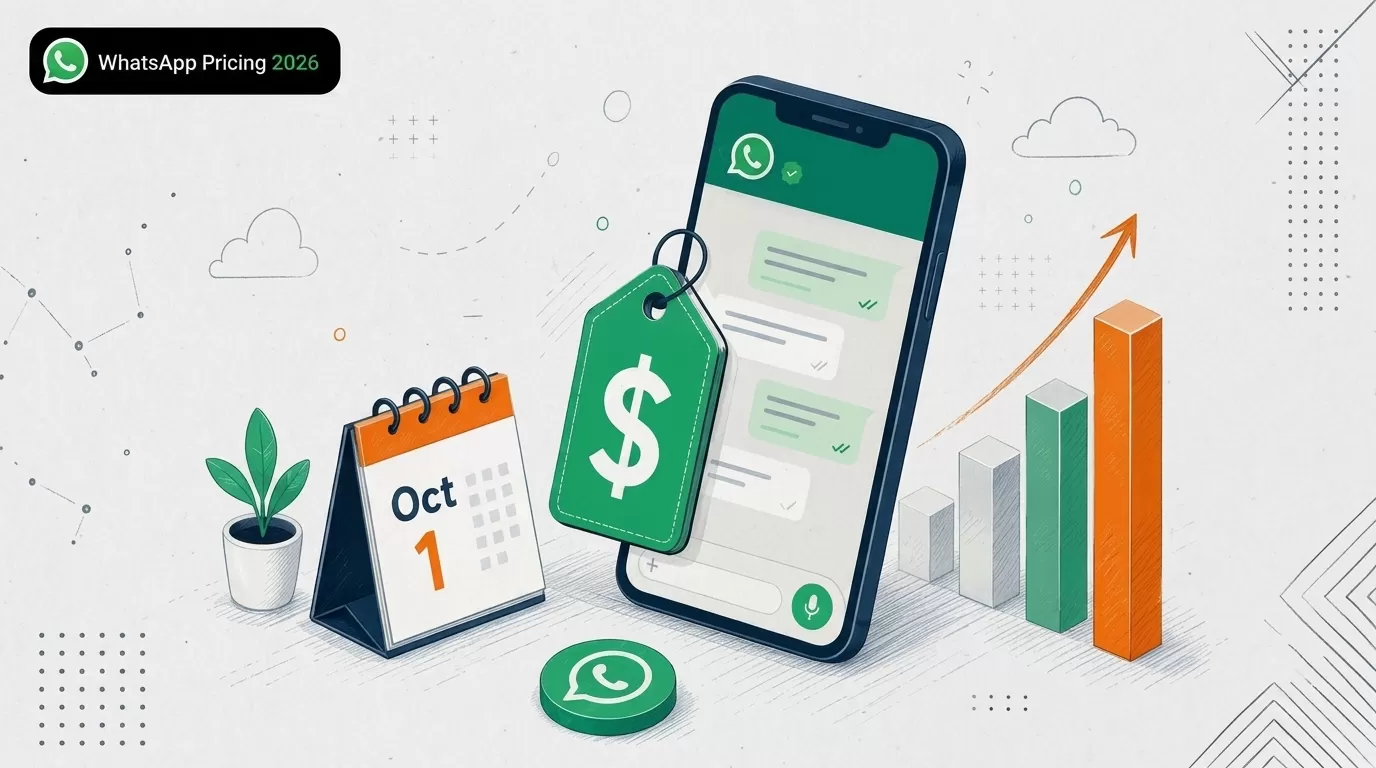
WhatsApp Business API pricing is a per-delivered-message charge set by Meta, which varies by message category and the recipient's country, plus whatever your provider adds on top. On 1 October 2026 the rules change for the messages most teams send the most of: customer-service replies stop being free. If your budget was built on "replies cost nothing," this guide shows what you will actually owe and how to keep the bill down.
Until 30 September 2026: Meta charges only for delivered templates (marketing, utility, authentication) sent to reach out. Service replies and utility replies inside an open 24-hour window are free.
From 1 October 2026: service messages are charged at each market's utility rate after 1,000 free per business phone number per month, and in-window utility replies are charged with no free tier. All rates below carry their effective date.
What Changes on 1 October 2026, and What Stays Free
According to Meta's WhatsApp Business Platform pricing documentation (updated 10 September 2026) , two free categories become billable in October, while one new charge has been live since August.
| Message type | Through 30 Sep 2026 | From 1 Oct 2026 | Rate basis |
|---|---|---|---|
| Service reply (non-template, by a person or third-party AI) |
Free since Nov 2024 | Charged after 1,000 free per business phone number per month | Market utility rate; no volume tiers |
| Utility template sent in reply (inside an open 24-hour window) |
Free since Jul 2025 | Charged , no free tier | Market utility rate |
| Marketing, utility, authentication sent to reach out | Charged | Charged; some market rates move | Market and category rate |
| Meta Business Agent reply | Charged since 1 Aug 2026 | No change | US$2.00 per 1M tokens, global |
| Anything in a 72-hour free entry point window | Free | Free | Click to WhatsApp ads and Page CTA buttons only; agent tokens still billed |
| Inbound and undelivered messages | Free | Free | Meta bills business-to-user delivery only |
Meta's own worked example makes the shift concrete: one customer, one hour, a marketing template followed by two agent replies, a human reply, and an order confirmation. That exchange was 1 billable message in July 2026, 3 in August, and becomes 5 on 1 October. For the full October playbook, see our breakdown of the 2026 service-message cost change .
The 1,000-message free tier, as Meta defines it
- Per business phone number , not per WhatsApp Business Account or portfolio. Charging starts at the 1,001st delivered service message.
- Monthly, no roll-over. Unused messages expire at month end.
- No payment method, no 1,001st message. Without one in Billing Hub, Meta stops delivering service messages at the allowance. Add one before 30 September 2026.
Expect conflicting answers online. As of 11 September 2026, Meta's business-facing pricing page and several provider pages still describe service replies as free, and some still describe the retired per-conversation model. The developer documentation and the 1 October rate card are what your invoice will match.
How WhatsApp Business API Pricing Works: 5 Categories, 2 Windows
Meta charges only when a message is delivered , at the rate for the recipient's country calling code, not where your business is registered. Which rate applies depends on the category:
- Marketing: promotions, offers, re-engagement. Template only, and the highest rate in every market.
- Utility: order updates, receipts, reminders. Template only.
- Authentication: one-time passcodes. Template only. Cross-border OTPs can carry a much higher authentication-international rate.
- Service: free-form replies from a person or third-party AI, sendable only inside an open window.
- Meta Business Agent: replies from Meta's own agent platform, billed per token instead of per message.
Only one charge applies per message: a non-template reply is billed as service or as Meta Business Agent, never both, and promotional wording in a reply does not add a marketing charge.
The two windows that decide what you can send and what you pay
A user message opens a 24-hour customer service window , which resets with each new user message. It still controls whether you can send a non-template reply; from October it no longer makes that reply free. A user arriving from a Click to WhatsApp ad or a Facebook Page CTA button opens a 72-hour free entry point window when you reply within 24 hours, and every category except Meta Business Agent stays free inside it. Meta confirms this window is unchanged by the October update.
Volume tiers apply to utility and authentication only
Utility and authentication get cheaper as monthly volume grows; marketing and service never do. Tiers are marginal, so crossing a threshold reprices only the messages above it. Volume aggregates across every WhatsApp Business Account in one business portfolio, per market–category pair, counts only billable messages, and resets monthly in the account's timezone. Meta publishes tier boundaries per market and currency rather than a headline discount, so read the tier file for your billing currency.
WhatsApp Business API Rates by Market: July vs October 2026
US dollars per delivered message from Meta's published USD cards. The left figure is effective 1 July 2026 and in force today; the right figure is effective 1 October 2026 , published 1 September 2026. Utility and authentication share one rate in every market below, and from October that same rate applies to service messages.
| Market | Marketing Jul 1 → Oct 1 |
Utility, authentication, service* Jul 1 → Oct 1 |
Auth-international Oct 1 |
|---|---|---|---|
| 🇺🇸🇨🇦 North America | 0.0250 → 0.0250 | 0.0034 → 0.0034 | n/a |
| 🇬🇧 United Kingdom | 0.0635 → 0.0635 | 0.0220 → 0.0220 | n/a |
| 🇩🇪 Germany | 0.1365 → 0.1365 | 0.0550 → 0.0550 | n/a |
| 🇮🇳 India | 0.0118 → 0.0118 | 0.0014 → 0.0014 | 0.0304 |
| 🇧🇷 Brazil | 0.0625 → 0.0625 | 0.0068 → 0.0068 | n/a |
| 🇮🇩 Indonesia | 0.0411 → 0.0411 | 0.0250 → 0.0250 | 0.1360 |
| 🇲🇽 Mexico | 0.0305 → 0.0397 ↑ | 0.0085 → 0.0085 | n/a |
| 🇦🇪 United Arab Emirates | 0.0499 → 0.0576 ↑ | 0.0157 → 0.0157 | 0.0510 |
| 🇸🇦 Saudi Arabia | 0.0501 → 0.0576 ↑ | 0.0107 → 0.0107 | 0.0598 |
| 🇵🇰 Pakistan | 0.0473 → 0.0473 | 0.0100 → 0.0150 ↑ | 0.0750 |
| 🇿🇦 South Africa | 0.0379 → 0.0379 | 0.0076 → 0.0095 ↑ | 0.0200 |
| 🌏 Rest of Asia Pacific | 0.0732 → 0.0842 ↑ | 0.0113 → 0.0113 | n/a |
| 🌍 Rest of Middle East | 0.0341 → 0.0392 ↑ | 0.0091 → 0.0091 | n/a |
| 🌐 Other | 0.0604 → 0.0604 | 0.0077 → 0.0077 | n/a |
*Service messages are free until 30 September 2026. Source: Meta USD rate cards effective 1 July and 1 October 2026, retrieved 11 September 2026 from Meta's pricing documentation , which lists every market. Meta publishes cards in 16 currencies; if you bill in another currency, use that card rather than converting. Rates change at most quarterly, on 1 January, 1 April, 1 July, or 1 October.
Two spreads matter more than any single number. Within one market, marketing costs about 1.6× the utility rate in Indonesia but about 7× in North America and 8× in India, so a template approved in the wrong category can outweigh any provider discount. Across markets, the same marketing message costs about 11× more in Germany than in India, so one blended rate will mislead a global budget in both directions.
Nine markets also leave their "Rest Of" region on 1 October 2026, which changes both their rate and the volume tier they accrue to. Utility, authentication, and service get cheaper in Sri Lanka (0.0020), Nepal (0.0034), Bangladesh (0.0037), and Iraq (0.0079), and more expensive in Kazakhstan (0.0180), Morocco (0.0230), Oman (0.0247), Ukraine (0.0298), and Kuwait (0.0440). All nine gain an authentication-international rate; in Sri Lanka it is 72× the domestic rate. Meta now assesses that rate across 18 markets instead of 9, with 30 days' notice before a business is first charged it.
How to Estimate Your Monthly WhatsApp API Cost: 3 Worked Examples
Estimate each market–category pair separately: delivered messages × Meta rate , then add provider fees, platform fees, and tax. The examples below use the USD rates above, one business phone number, no volume tier, and Twilio's published US$0.005 fee as an illustration of a pass-through provider. That fee applies to inbound messages too, so a support team's real provider cost is higher than the outbound figure shown.
| Scenario | Meta fees today | Meta fees from 1 Oct | Provider fee (outbound) |
|---|---|---|---|
| Startup 5,000 marketing templates to India |
5,000 × 0.0118 = $59.00 | $59.00 (no change) | $25.00 |
| Support team 20,000 service replies to Brazil |
$0 | 19,000 × 0.0068 = $129.20 (+$129.20) | $100.00 |
| Retail brand 30,000 marketing + 20,000 in-window utility to the UK |
30,000 × 0.0635 = $1,905.00 | $1,905.00 + 20,000 × 0.0220 = $2,345.00 (+$440.00) | $250.00 |
Marketing-led senders barely notice October; support-led and transactional senders absorb the whole change. The 1,000-message allowance covers only 5% of the support team's volume above. Outside the message rate, budget for integration engineering, template drafting and re-submission, provider seat or inbox fees (often the largest line for small senders), and tax and FX. If you bill through India or Brazil, Meta requires eligible accounts to migrate to INR by 31 December 2026 and to BRL by 30 June 2027, and stops delivering on non-migrated accounts after those dates.
Provider Fees Compared: 3 Pricing Models to Check Before You Sign
Meta's rate is identical whichever Business Solution Provider you use. Providers differ in how they add their margin, and the three models below are not directly comparable, so identify the model before comparing two quotes.
| Provider | Fee model | Published figure | What to verify |
|---|---|---|---|
| Twilio | Meta fee passed through at cost, plus a Twilio fee | US$0.005 per message , inbound or outbound (page dated August 2026) | Volume discounts at your tier; platform fees are not published |
| Bird | All-in rate with Meta's fee bundled | US: marketing 0.0300, utility 0.0084, authentication 0.0084, service 0.0050 | Margin cannot be separated from Meta's fee; no effective date shown |
| Vonage | Meta fee billed separately, plus a tiered platform fee | Quote-only; "as low as" €0.0001 per message cited, no WhatsApp table | Request the tier table; public page still describes the retired conversation model |
| EngageLab | Entity-specific quote by market, category, and volume. For overseas entities , EngageLab passes through Meta's official price at cost with no additional service fee; for Mainland China entities , the official Meta charge applies together with an additional server-resource consumption fee. Meta and EngageLab settle in USD; price changes are notified one month in advance. | Not published; contact sales | Confirm the entity location, applicable fee structure, and that the quote reflects the one-month advance notice for price changes. |
Retrieved 11 September 2026 from each provider's pricing page. Vonage's page was unreachable; figure from an archived snapshot dated 11 February 2026.
Whichever provider you choose, ask for a quote that shows Meta's fee and the provider's fee as separate lines, a console that reports delivered volume by market and category (the basis of the invoice), a billing view that separates service messages and shows the free-tier counter after October, and a template workflow non-engineers can run. A provider with no per-message fee but months of integration work is not cheaper than one with a visible fee and a working console.
EngageLab's WhatsApp Business API covers template management across all three template categories, sending-number administration, and delivery reporting in one console; shared inbox and journey building are separate products (LiveDesk and Marketing Automation) with their own pricing. The useful pre-October check is per-message cost: send a small test batch and open History to confirm which category Meta actually billed.

Then open Conversation Analysis and filter by sending number: today's free service column, per number, is roughly next quarter's new invoice line.

Finally, compare planned , sent , delivered , and read volume in Messages Analysis . Because Meta bills on delivery, the gap between sent and delivered is the gap between what you budgeted and what you owe.

Create a free account, connect a sender, and read your own per-number, per-category numbers in these views before 1 October instead of estimating them.
7 Ways to Cut WhatsApp API Costs Before 1 October
WhatsApp Business API pricing is about to stop rewarding the habit most teams optimised for: pushing conversations into the free service window. Every step below still holds after the rule change.
- Size your exposure per number. Pull delivered service messages per business phone number, subtract 1,000, and multiply by that market's utility rate.
- Confirm a payment method in Billing Hub before 30 September, or delivery stops at the 1,001st service message.
- Audit template categories. A receipt approved as marketing costs about 7× the utility rate in North America on every send.
- Resolve in fewer turns. Once replies are billable, a three-message answer costs three times a one-message answer.
- Use free entry point windows deliberately. Click to WhatsApp ads and Page CTAs still open 72 free hours after October.
- Consolidate accounts under one business portfolio so utility and authentication volume reaches tiers faster.
- Check authentication-international exposure if you send OTPs across borders, especially into the nine newly standalone markets.
Still deciding whether the API is the right tier? Compare WhatsApp Business App, Premium, and API pricing , or follow the guide to send a WhatsApp message via API . To see this breakdown from a live console instead of a spreadsheet, create a free EngageLab account and review delivered volume by market and category before the new rates apply.
WhatsApp Business API Pricing FAQ for 2026
Is WhatsApp Business API free?
No. There is no licence fee, but Meta charges per delivered marketing, utility, and authentication template, and your provider may add its own fee. From 1 October 2026, service replies are also charged beyond the first 1,000 per business phone number each month. Messages inside a 72-hour free entry point window remain free.
How much does WhatsApp Business API cost per month?
It depends on delivered volume, category mix, and recipient markets. On Meta's July 2026 USD card, 5,000 marketing templates to India cost about $59 in Meta fees, while 30,000 to the UK cost about $1,905. Add provider fees, and model the October change separately if you send customer-service replies.
How much does WhatsApp API cost per message?
On Meta's USD card effective 1 July 2026, marketing ranges from $0.0109 in Turkey to $0.1597 in the Netherlands, and utility and authentication from $0.0008 in Colombia to $0.0550 in Germany. If your account bills in one of Meta's 15 other currencies, use that card rather than converting from USD.
Are WhatsApp service messages free after 1 October 2026?
Only the first 1,000 per business phone number per month. From the 1,001st, Meta charges each delivered service message at that market's utility rate, with no volume discount. The allowance resets monthly and does not roll over. The 24-hour window still controls when you can send a free-form reply.
Does Meta charge for failed WhatsApp messages?
Meta charges only when a message is delivered, so a message that fails to deliver does not produce a delivered-message charge. Meta states the delivery trigger rather than a separate failed-message policy, so budget from delivered volume, not sends, and reconcile against your provider's delivery reporting.
How are WhatsApp authentication messages priced?
Per delivered message, at the same rate as utility in most markets. Cross-border OTPs can instead carry an authentication-international rate, which Meta assesses across 18 markets from 1 October 2026. The gap is large: India's international rate is about 22× its domestic authentication rate.