Jacob Morrow
Updated: 2026-06-08
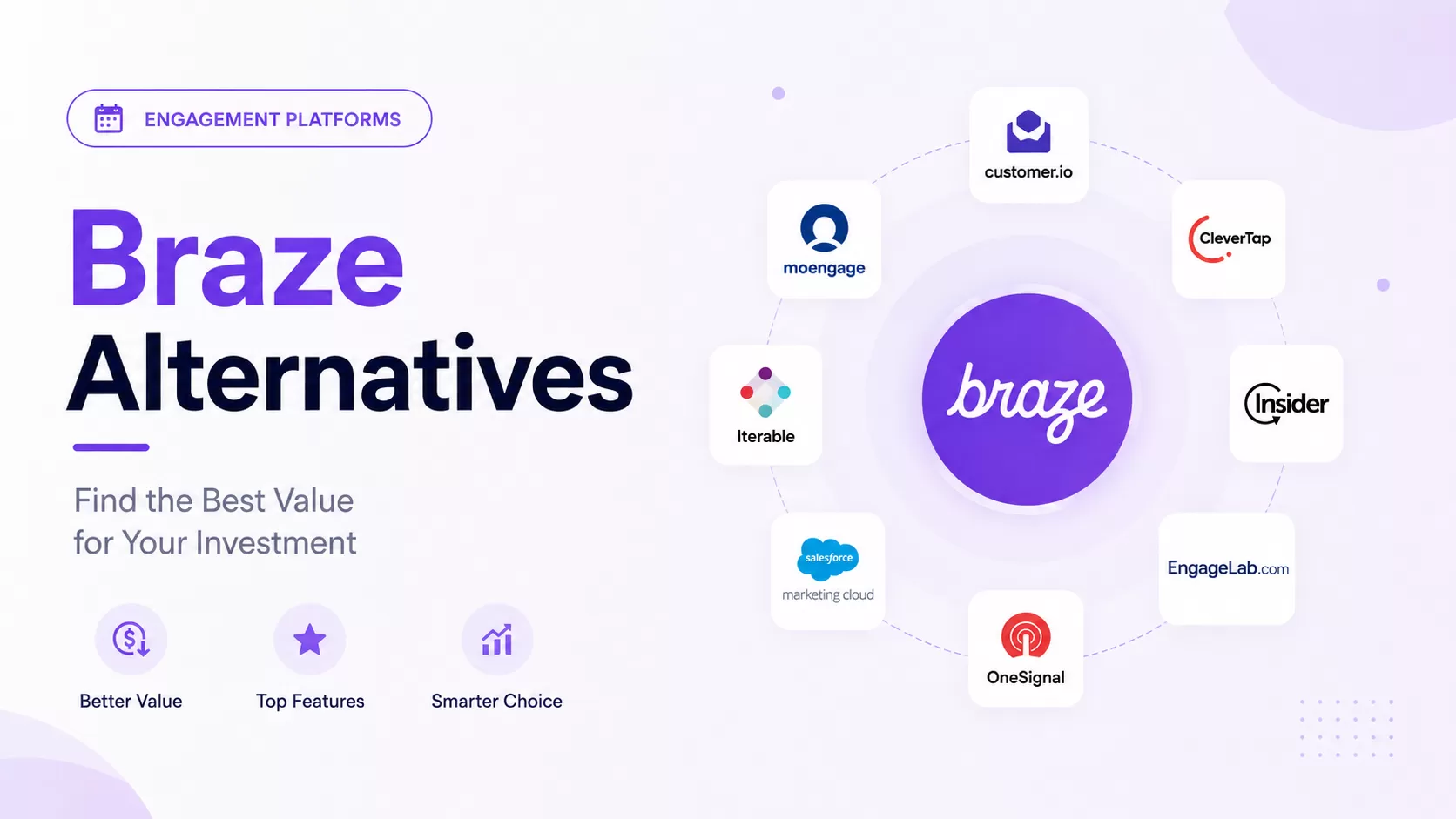
The moment a growth team gets a six-figure Braze renewal quote is the moment they start hunting for a Braze alternative . Reported entry contracts now sit between $43,000 and $72,000 per year (public RFP disclosures, as of June 2026), implementation typically requires partner or solutions-engineer support, and Android push delivery in mainland China and parts of Southeast Asia is bottlenecked by Google FCM rather than native OEM channels. This guide compares the 8 strongest Braze competitors in 2026, grouped by price tier so you can shortlist by budget first and feature second.
Quick answer
A Braze alternative is a customer engagement platform that delivers cross-channel messaging (push, email, SMS, in-app) without Braze's six-figure floor. For budget teams under $200/mo, OneSignal and Customer.io Essentials work; mid-market teams ($200 to $2,000/mo) lean toward CleverTap, MoEngage, or Iterable; enterprise buyers compare Salesforce Marketing Cloud or Insider. APAC teams with OEM push needs (Xiaomi, OPPO, Huawei) usually shortlist a regional vendor as well.
Why Teams Look for a Braze Alternative in 2026
Braze remains a strong cross-channel platform, but three structural reasons keep growth teams shopping for substitutes.
1. Pricing floor. Braze does not publish a self-serve plan. Entry contracts disclosed in public US municipal RFPs and SaaS-procurement databases land between $43,000 and $72,000 per year (as of June 2026), with usage-based escalation on monthly active users and message volume. According to G2 (2026), the most cited "dislike" theme in Braze reviews is "pricing not competitive for small to mid-size teams."
2. Implementation cost. Braze's Currents data export, Catalogs, and Cloud Data Ingestion all reward teams with in-house data engineers. According to Forrester (2025), enterprise CDP-class deployments take a median of 17 weeks, and Braze sits in that band. Solo marketers and SMB stacks rarely have that runway.
3. APAC push delivery. Braze ships push via FCM and APNs by default. In mainland China, FCM is throttled and many OEMs (Xiaomi, OPPO, Huawei, Vivo) use proprietary push services. Teams shipping to Greater China, Indonesia, Vietnam, or Thailand often layer a regional vendor to recover delivery rates.
Translation: if your team has a five-figure budget, an in-house data engineer, and an APAC compliance lead, Braze is still defensible. If any of those three is missing, the rest of this list matters.

8 Best Braze Alternatives and Competitors at a Glance
Use this table to shortlist 2 or 3 vendors based on budget and primary use case, then read the price-tier sections below for product detail.
| Tool | Best fit | Starting price (June 2026) | Watch-out |
|---|---|---|---|
| OneSignal | Budget push-first teams | $19/mo | Light on lifecycle orchestration |
| Customer.io | Developer-led SaaS | $100/mo | UI assumes engineering support |
| EngageLab | APAC + OEM push, DAU pricing | Usage-based, free tier | Smaller ecosystem outside APAC |
| CleverTap | Mobile-first growth teams | ~$90/mo | Pricing scales sharply with MAU |
| MoEngage | Insights-led mid-market | Custom (mid-tier) | No public pricing |
| Iterable | Cross-channel mid-market brands | Custom (mid-tier) | Heavier setup than Braze |
| Insider | AI personalization for retail and travel | Custom (enterprise) | CDP fit varies by data quality |
| Salesforce Marketing Cloud | CRM-native enterprises | $1,500/mo | Steep learning curve, multi-product stack |
Best Braze Alternatives Under $200/Month for Startups and Solo Founders
This tier suits solo founders, indie apps, and seed-stage startups. The trade-off is fewer enterprise governance features (granular roles, SCIM, audit logs).
1. OneSignal

OneSignal anchors push notifications (web, mobile, in-app) with paid add-ons for email and SMS. The free plan covers up to 10,000 web subscribers and unlimited mobile push, which is unusual at this tier. The Growth plan starts at $19/mo (as of June 2026), Professional at $99/mo, and Enterprise is custom.
Best fit when: push is your primary channel, you do not yet have a marketing automation budget, and you want to launch in days, not weeks. Skip if: you need deep journey orchestration across email plus SMS plus push from one builder. For a closer look at OneSignal trade-offs, read our OneSignal alternatives breakdown .
2. Customer.io (Essentials)

Customer.io is the developer-friendly lifecycle messaging tool: APIs are first-class, the visual journey builder is fast, and segmentation runs on real-time event data. The Essentials plan starts at $100/mo for 5,000 profiles (as of June 2026), then scales by profiles and email volume.
Best fit when: your team has engineering capacity, you want event-triggered journeys without a CDP-heavy stack, and you ship behavioural email plus push together. Skip if: your marketing team prefers no-code UIs.
3. EngageLab (Pay-as-you-go)

EngageLab is the Braze alternative to evaluate when your growth team needs more than email and standard FCM push. It brings app push , web push , email, SMS , WhatsApp Business API , in-app messaging, and Marketing Automation journeys into one stack, with DAU-based pricing for teams whose active users are a smaller slice of their total registered base.
Best fit when: Android push needs to land via OEM channels (Xiaomi, OPPO, Huawei, Vivo), your active-user count is much smaller than your total registered base, or you need a native LiveDesk inbox for inbound WhatsApp and webchat. See the APAC messaging infrastructure section below for the detailed breakdown.
Map your journey before you pick a vendor
List the channels, triggers, and conversion goals you actually need. The shortlist falls out of that, not the other way around.
Best Braze Alternatives From $200 to $2,000/Month: CleverTap, MoEngage, Iterable
This is the sweet spot for Series A to Series C apps with a marketing or growth team but no full CRM department. Pricing usually shifts to custom contracts above 25,000 to 50,000 MAU.
4. CleverTap

CleverTap is the closest direct Braze rival on mobile orchestration. Its TesseractDB stores real-time event data, RFM segmentation is built in, and the journey builder supports A/B/n testing. The Essentials plan starts around $90/mo for 5,000 MAU (as of June 2026), with Advanced and Cuper plans custom-priced.
Best fit when: mobile is 70%+ of your channel mix, you want behavioural cohorts without external CDP, and you care about RFM-based lifecycle messaging. Skip if: email is your primary channel.
5. MoEngage

MoEngage built its reputation on "insights-led engagement": Sherpa AI surfaces best send time, best channel, and best content per user. It supports email, push, SMS, WhatsApp, in-app, and on-site channels. Pricing is not public; mid-market deals typically land in the $1,000 to $2,000/mo range.
Best fit when: your team values AI-generated send-time and channel recommendations, you have an APAC or MEA footprint where MoEngage has strong regional support, and you want analytics-led campaign decisions. Skip if: you prefer transparent self-serve pricing.
6. Iterable

Iterable is the most direct mid-market peer to Braze on cross-channel orchestration: email, push, SMS, in-app, web, and direct mail run from one journey builder. Pricing is custom; mid-market deals usually sit in the $1,500 to $5,000/mo band.
Best fit when: email is a primary channel alongside push, you want a single workflow for lifecycle plus campaign sends, and your team needs catalog-driven personalization for retail or media. Skip if: your team is smaller than 5 marketers; the platform rewards organized ops.
Enterprise Braze Alternatives: Salesforce Marketing Cloud and Insider
Above $2,000/mo the calculation changes. Buyers compare CDP fit, governance, and consulting-partner ecosystem more than per-channel UX.
7. Salesforce Marketing Cloud

Salesforce Marketing Cloud (Engagement) is the CRM-native option, especially for teams already on Sales Cloud or Service Cloud. Plans now start at Growth $1,500/mo for 5,000 contacts, Professional $3,250/mo for 75,000 contacts, and Corporate $12,500/mo+ (as of June 2026).
Best fit when: Salesforce CRM is the system of record, you need Journey Builder plus Data Cloud, and you have implementation partner budget. Skip if: your team is mobile-first; Salesforce push and in-app remain weaker than Braze, CleverTap, or MoEngage.
8. Insider

Insider positions itself as an AI-native individualized marketing platform. According to Gartner (2025), Insider was named a Leader in the Magic Quadrant for Personalization Engines for the fourth consecutive year. It supports web, app, email, push, SMS, WhatsApp, and on-site personalization, with predictive segments (likelihood to purchase, likelihood to churn).
Best fit when: retail, travel, or media brands need on-site personalization plus cross-channel orchestration, your data is clean enough for ML segments, and predictive cohorts are a real workflow. Skip if: you do not have catalog and event data quality to feed the ML layer.
Should You Switch From Klaviyo, Iterable, MoEngage, or CleverTap to Braze?
Long-tail search queries like "is Braze a good alternative to Klaviyo" usually mean the reader is on a smaller tool and wondering whether Braze is the upgrade. Most of the time the honest answer is "not yet, switch laterally instead." Use this decision matrix.
Decision shortcut
| If you are on Klaviyo | Stay on Klaviyo for e-commerce email and SMS. If you must add mobile push and in-app, consider CleverTap or a regional push vendor before jumping to Braze. Braze is overkill for D2C under $20M GMV. |
| If you are on Iterable | Stay. Iterable and Braze cover the same buyer; migration cost rarely pays back. Only switch if a specific Braze capability (Currents export, real-time personalization) is a board-level requirement. |
| If you are on MoEngage | Compare on price, not features; both serve mid-market mobile teams. If you are APAC-anchored, MoEngage's regional support is usually stronger than Braze. |
| If you are on CleverTap | Comparable platforms. Switching usually delivers single-digit lift unless Braze's catalog or Currents specifically unblock revenue. Renegotiate CleverTap first. |
| If you are on Adobe Campaign or Salesforce MC | Braze can be a real upgrade on mobile, real-time, and developer ergonomics. The blocker is CRM dependency: if Salesforce or Adobe is the system of record, expect integration work. |
The pattern: switching to Braze is justified when you are leaving a CRM-centric suite (Adobe, Salesforce) and need real-time mobile orchestration. Lateral moves between Braze-class tools (Iterable, MoEngage, CleverTap, Customer.io) usually do not pay back.
How APAC Messaging Infrastructure Compares to Braze on Pricing and OEM Push

For teams with a meaningful APAC user base, the comparison is less about feature count and more about routing, pricing, and support operations. These are the three checks that usually decide whether Braze is still the right fit.
OEM push routing. Braze ships Android push through FCM. EngageLab routes the same campaign through Xiaomi MiPush, OPPO Push, Huawei Push, Vivo Push, and Meizu Push, with FCM as fallback. In mainland China where FCM is rate-limited, this difference shows up as a delivery rate gap, not a setup nicety. Aurora Mobile (NASDAQ: JG) has operated this push infrastructure for billions of devices, which is how the integration exists at all.
DAU-based pricing. Braze's commercial model scales with MAU and message volume. The Marketing Automation product prices on DAU. For apps with large dormant pools (gaming, fintech, freemium SaaS), the DAU model can cut effective unit cost materially. Validate with your own ratio before signing.
Inbound conversation handling. Braze focuses on outbound orchestration. The same stack pairs Marketing Automation with LiveDesk , a multi-channel agent inbox for inbound WhatsApp, SMS, webchat, and email with AI auto-reply and ticketing. That removes the need to bolt on a separate helpdesk vendor if customer conversations happen in messaging channels.
Shortlist this path when:
- You ship Android push to mainland China or Greater APAC and need OEM channels, not just FCM.
- You want DAU-based pricing because your active-user ratio is well below your total user base.
- You need outbound marketing automation plus inbound LiveDesk inbox from one vendor.
For deeper background on the wider category, see our reviews of customer engagement software and marketing automation services .
Bottom Line: Picking a Braze Alternative in 2026
Start with budget and the capability gap you actually need to close. Under $200/mo, OneSignal works for push-first basics, Customer.io Essentials fits developer-led lifecycle messaging, and EngageLab is the practical shortlist pick when you need native OEM push, DAU-aligned pricing, and Marketing Automation plus LiveDesk in one stack. In the $200 to $2,000/mo band, CleverTap, MoEngage, and Iterable are the closest functional rivals to Braze itself. Above $2,000/mo, the question becomes CDP and CRM fit, where Salesforce Marketing Cloud and Insider compete with Braze on different axes.
Frequently Asked Questions About Braze Alternatives
Who are Braze's main competitors in 2026?
Braze's main competitors are CleverTap, MoEngage, Iterable, and Customer.io among Braze-class peers, and Salesforce Marketing Cloud, Insider, and Adobe Experience Cloud at the enterprise tier. OneSignal competes on push-only budgets. For APAC teams, native OEM push channels (Xiaomi, OPPO, Huawei, Vivo) and regional routing usually matter more than broad enterprise feature lists.
What is the cheapest alternative to Braze?
OneSignal is the cheapest published option, starting at $19/mo (as of June 2026) with a generous free tier for push. Customer.io Essentials starts at $100/mo and adds journey orchestration. If your main cost problem is paying for total profiles instead of active users, also compare DAU-based or send-volume-based pricing before signing another annual contract.
Is Braze a good alternative to Klaviyo?
Usually no. Klaviyo is e-commerce-native (Shopify integration, product feeds, SMS for D2C). Braze is built for product apps with mobile push and in-app orchestration. They serve different buyers. If you are scaling D2C and adding mobile, look at Klaviyo plus a push tool (OneSignal or a regional push vendor) before migrating to Braze.
Is Braze a good alternative to CleverTap or MoEngage?
They are peers, not upgrades. Braze, CleverTap, and MoEngage all serve mobile-first mid-market growth teams with cross-channel orchestration. Switch only when a specific capability gap is blocking revenue (Braze's Currents data export, CleverTap's TesseractDB for real-time RFM, or MoEngage's regional APAC support).
How much does Braze cost compared to competitors?
Reported entry contracts for Braze run $43,000 to $72,000 per year (public RFP disclosures, as of June 2026), with usage-based escalation. Iterable and MoEngage usually quote 30 to 50% lower for similar workloads. CleverTap and regional APAC alternatives can come in well under that at SMB scale. OneSignal and Customer.io Essentials live below $5,000/year.
Are regional push vendors a real Braze alternative for teams shipping to China?
Yes for the specific use case: shipping mobile push to Android users in mainland China or Greater APAC, pricing on DAU instead of total profiles, or wanting Marketing Automation plus a LiveDesk inbound inbox from one vendor. The trade-off is a smaller ecosystem outside APAC, so North America or EMEA-only deployments may prefer Braze, Iterable, or CleverTap.